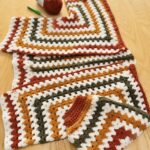
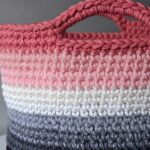
A beautifully textured stitch that looks like scattered stars across the fabric — and works up far more easily than it appears.
The Stitch That Looks Like It Took Much Longer Than It Did
There are certain crochet stitches that earn their place in your permanent collection not because they are complicated, but because they are clever. The Trinity Stitch is one of them. The finished fabric has a softly raised, almost star-like texture that makes people stop and look closer, and yet the repeat is simple enough to work while watching television, having a conversation, or simply letting your hands move while your mind rests somewhere else entirely.
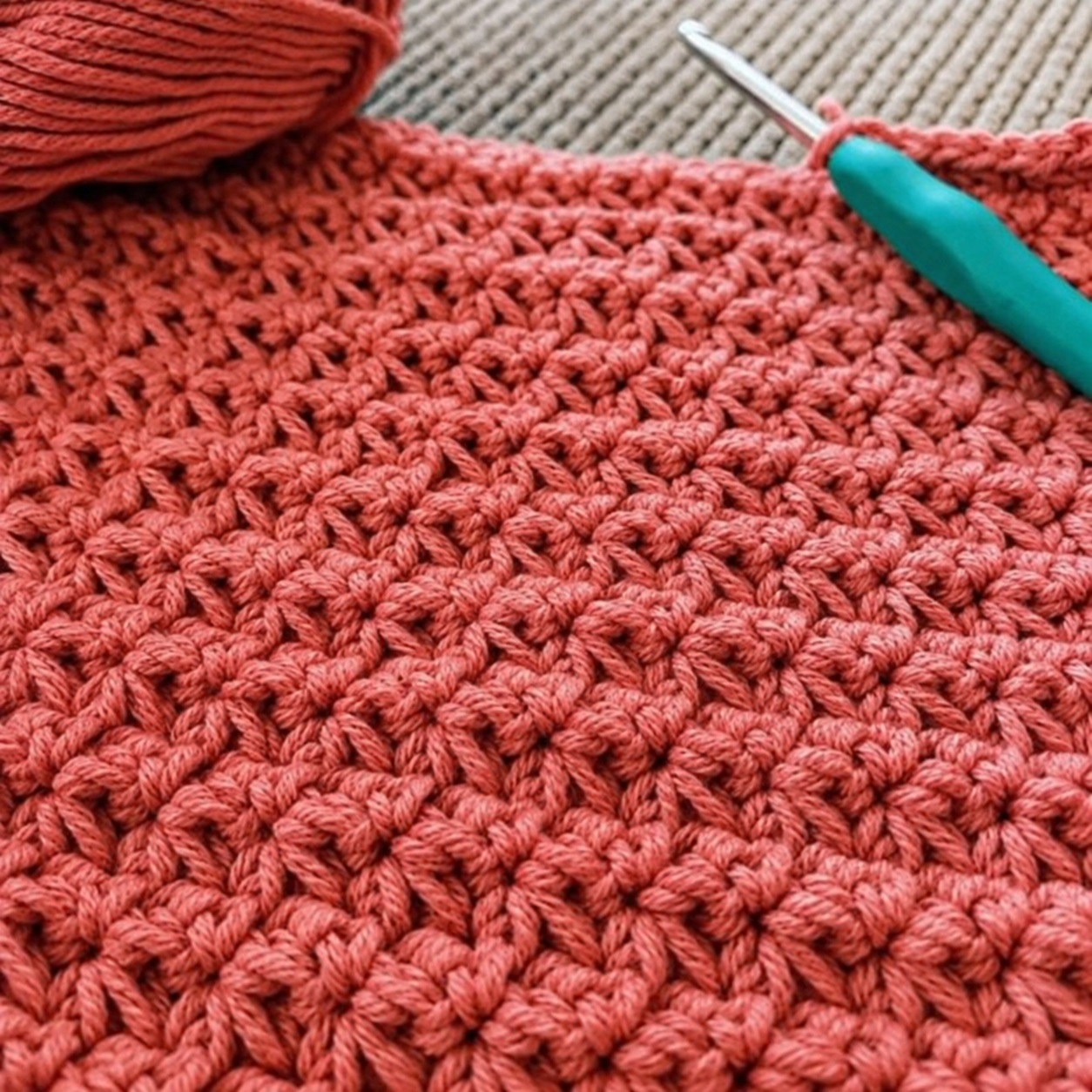
The secret behind the stitch is a small but brilliant detail: each sc3tog cluster begins in the same stitch where the previous cluster ended. That single overlap is what creates the interlocking, textured shapes that give Trinity Stitch its characteristic appearance. Once you understand that one thing, the entire stitch makes sense, and the rhythm of it follows naturally.
If you already know how to work a single crochet, you are much closer to mastering this stitch than you might think. The foundation is an even number of chains. Row 1 establishes the pattern. Row 2 is the repeat, and you simply work that same row until your piece reaches the length you want. That is the whole structure.
Why This Stitch Is Worth Learning
The Trinity Stitch produces a dense, slightly stiff fabric with beautiful surface texture — the kind of fabric that works well for blankets, scarves, bags, washcloths, and home decor projects where a little structure is an advantage rather than a limitation. If you want a softer, more drapier result, simply move up one or two hook sizes and the same stitch becomes noticeably more relaxed without losing its texture.
What makes it particularly appealing for longer projects is the consistency of the repeat. You are not tracking a ten-row sequence or switching between different construction methods every few inches. After the first row establishes the stitch positions, every subsequent row is the same movement across: a single crochet at the edge, overlapping sc3tog clusters with chain-one spaces between them, and a single crochet at the opposite edge before turning. Your hands will memorize it within the first ten minutes, and from that point it becomes genuinely meditative to work.
The texture also has a quality that is rare in easy stitches — it looks interesting from a distance but even more interesting up close. The way the clusters overlap and nest creates small raised shapes that catch the light differently depending on the yarn you use. In a smooth, solid yarn the pattern is crisp and defined. In a softer or slightly variegated yarn it becomes more subtle and organic. Both versions are beautiful in their own way.
Materials
The Trinity Stitch works with any yarn and any corresponding hook size. The only meaningful choice is the hook-to-yarn ratio, which determines how dense or drapey the finished fabric will be. A worsted weight yarn with a 5.0 or 5.5 mm hook produces a firm, structured fabric well suited to bags and heavier blankets. Moving up to a 6.0 or 6.5 mm hook with the same yarn gives you a slightly softer result that works better for scarves and lightweight throws. For baby items or anything that needs to be very soft, a DK or sport weight yarn with an appropriately sized hook gives you the texture of Trinity Stitch with a finer, gentler hand.
You will need yarn in your chosen weight and color, a crochet hook appropriate for that yarn, a yarn needle for weaving in ends, and scissors. No additional materials are required.
Abbreviations
ch — chain
sc — single crochet
sc3tog — single crochet 3 together
st(s) — stitch(es)
ch-sp — chain space
yo — yarn over
Stitch Multiple
Begin with any even number of chains. The pattern works on any even foundation chain, which means you can make this stitch as narrow or as wide as you like without any complex calculations.
Special Stitch: sc3tog
The sc3tog used in Trinity Stitch is slightly different from a standard decrease because of where each cluster begins. In a typical sc3tog, the three legs of the cluster are worked into three consecutive and separate stitches. In Trinity Stitch, the first leg of each new cluster is worked into the same stitch where the previous cluster ended. That shared stitch is what creates the overlapping structure and the raised textured shapes across the fabric.
To work a sc3tog in Trinity Stitch:
Insert your hook into the indicated stitch. Yarn over and pull up a loop. Insert your hook into the next stitch. Yarn over and pull up a loop. Insert your hook into the following stitch. Yarn over and pull up a loop. You now have four loops on your hook. Yarn over and pull through all four loops. The sc3tog is complete.
When working the first sc3tog of a cluster sequence, the first insertion point is the same stitch where the previous cluster’s final leg was worked. Keep that detail in mind as you work through the first row, and the overlap will begin to feel natural very quickly.
The Pattern
Foundation
Chain any even number of stitches.
Row 1
Single crochet in the 2nd chain from the hook. Work 1 sc3tog beginning in that same chain where you just worked the single crochet, then continuing across the next 2 chains. Chain 1.
Work the next sc3tog beginning in the same chain where the previous sc3tog ended, then continuing across the next 2 chains. Chain 1.
Continue in this manner across the row, working each sc3tog so that its first leg begins in the same chain where the previous cluster ended, followed by chain 1 after each completed cluster.
When you reach the end of the row, work the final sc3tog as established. Do not chain 1 after the final cluster. Instead, work a single crochet into the same chain where the final leg of the last sc3tog was worked. Turn.
The missing chain 1 at the end of the row is intentional and important. It is what keeps the side edges straight and even rather than gradually expanding outward.
Row 2
Chain 1. Single crochet in the first stitch.
Work a sc3tog beginning in that same first stitch. For the remaining two legs of this cluster, work into the top of the next sc3tog from the previous row and then into the next chain-1 space.
Chain 1.
Continue working sc3tog clusters across the row, always beginning each new cluster in the same stitch where the previous cluster ended. Each sc3tog top and each chain-1 space from the previous row functions as a stitch position as you work across.
At the end of the row, work the final sc3tog as established. Do not chain 1. Work one single crochet into the same stitch as the final leg of the last sc3tog. Turn.
Row 3 and Beyond
Repeat Row 2 until your piece reaches the desired length. From this point forward the pattern is a single repeating row. Once your hands are accustomed to the movement — single crochet at the edge, overlapping clusters with chain-1 spaces between them, single crochet at the opposite edge — the stitch becomes self-guiding and genuinely relaxing to work.
Tips for Working Trinity Stitch Successfully
The most important thing to remember as you work is that every new sc3tog begins in the same stitch where the previous cluster ended. This is the rule that everything else in the stitch depends on. If the texture is not forming correctly or the row counts are coming out inconsistently, this is almost always the point to check first.
Keep the loops of your sc3tog clusters at a consistent height as you pull them up. Loops that are pulled too tightly make the fabric stiff and dense in a way that is difficult to correct later. If you tend to crochet tightly, moving up half a hook size can make a noticeable difference in how comfortable and even the clusters feel.
Pay particular attention to the first and last stitches of every row. The single crochets at each edge are what keep the sides of your work straight. If those edge stitches are missed or doubled, the sides will gradually slant or expand in a way that affects the finished shape.
If the first few clusters feel awkward or stiff, continue for another five or six and then reassess. The sc3tog is a stitch that feels unfamiliar before it feels natural, and most crocheters find that the movement becomes intuitive more quickly than they expected. A small practice swatch of ten to fifteen chains worked over several rows is the best way to get comfortable before committing to a larger project.
Adjusting the Size
Because the only requirement for the foundation chain is an even number of stitches, the Trinity Stitch scales effortlessly to any project size. For a dishcloth or small swatch, chain 20 or 24 and work until the piece is square. For a scarf, chain until the foundation reaches your preferred width — typically somewhere between 40 and 60 chains depending on how wide you want it — and work the repeat until the scarf reaches your desired length. For a blanket, simply chain an even number until the foundation spans the width you want, then work Row 2 repeatedly until the blanket reaches the length you need.
The stitch does not require you to plan the width around a complex multiple, which makes sizing decisions genuinely simple. Choose your width, chain an even number close to it, and begin.
Color and Yarn Suggestions
Trinity Stitch shows its texture most clearly in smooth, solid yarns where nothing competes with the pattern itself. Soft neutrals like cream, oat, and warm white make the raised clusters particularly visible and give finished pieces a clean, timeless quality. Cool tones like dusty blue, sage green, and soft grey give the texture a quieter, more understated character. Warm tones like blush pink, terracotta, and mustard bring out the warmth of the overlapping shapes and work especially well for home decor and cozy accessories.
Lightly heathered or tonal yarns also work beautifully with this stitch. The subtle color variation moves across the surface of the fabric in a way that highlights the texture without overwhelming it. Highly variegated yarns tend to compete with the pattern, so if you want the Trinity shapes to read clearly, a yarn with minimal color variation will serve the stitch better.
Project Ideas
A Trinity Stitch blanket in a soft worsted weight yarn is one of the most satisfying versions of this stitch. The dense fabric has a lovely weight to it, and the texture gives the finished blanket a handmade quality that reads as genuinely special rather than simply practical. A baby blanket in DK weight yarn with a slightly larger hook produces a lighter, softer version of the same effect that is ideal for a nursery or a gift.
For a quick, rewarding project, a Trinity Stitch scarf or cowl works up beautifully and gives you a chance to experience the full rhythm of the stitch without committing to a large piece. The dense fabric makes it naturally warm, and the texture gives it a polish that simple single crochet scarves rarely achieve.
Bags and totes are another excellent application. The structure of the Trinity Stitch fabric means that a tote bag worked in this stitch holds its shape well without needing additional lining or interfacing. Washcloths and face cloths in cotton yarn are another practical use — the texture is gentle enough for skin and the dense fabric holds up well through repeated washing.
Final Thoughts
The Trinity Stitch is one of those techniques that rewards the ten or fifteen minutes it takes to learn it with a stitch you will return to again and again. It is easy enough to be accessible to anyone who can work a single crochet, textured enough to make even a simple project feel considered and beautiful, and consistent enough in its repeat to work on without losing your place or your focus.
Make a small swatch first. Get comfortable with the overlap. Notice how the clusters begin to nest against each other as the rows build up. And then start thinking about all the blankets, scarves, bags, and quiet little projects that are about to get a great deal more interesting.